The agreement is in an email. The reason for the price is in a call nobody wrote down. The number that would settle it was in a statement you filed in March.
01What it is
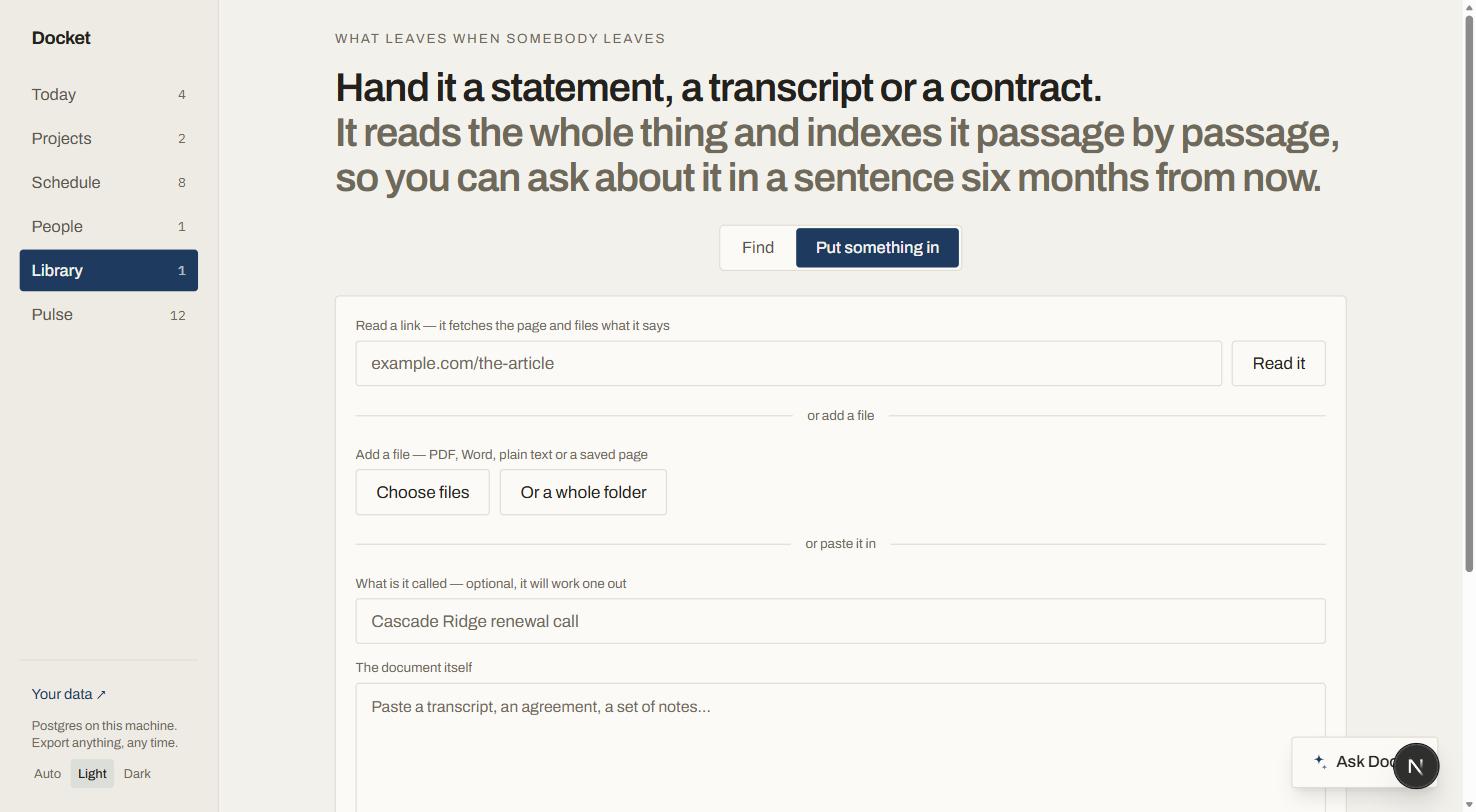
Docket takes your documents, decisions, commitments and numbers in through whichever door is nearest — a paste, a link, a file, a whole folder — and reads every one of them passage by passage.
Then you ask for it in a sentence, the way you would ask somebody who was in the room. Not a filename, not a folder, not a record number.
It runs on a Postgres database you own, on your own machine, and the AI assistant you already use can read it through one open interface.
02The problem
A point-of-sale captures every sale. A scheduler captures every job. Each one is faithful about its own slice, and each one is a locked room.
The questions that cross two tools, or reach back further than this quarter, get answered from somebody's memory or not at all.
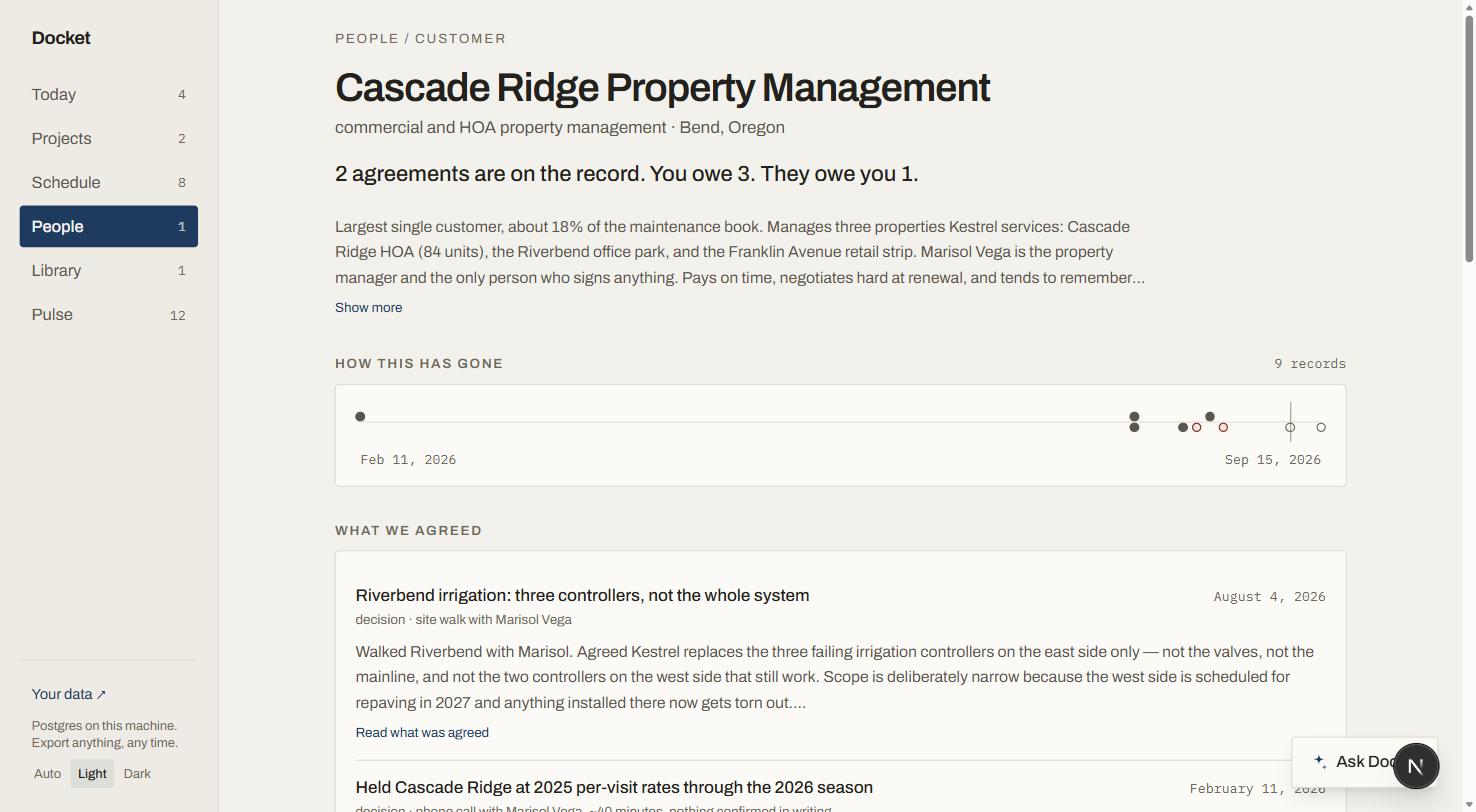
What was agreed is its own dated record, attached to the person and the company. The timeline always draws today, so a relationship that went quiet shows as an empty run rather than as a cluster filling the width.
03Today
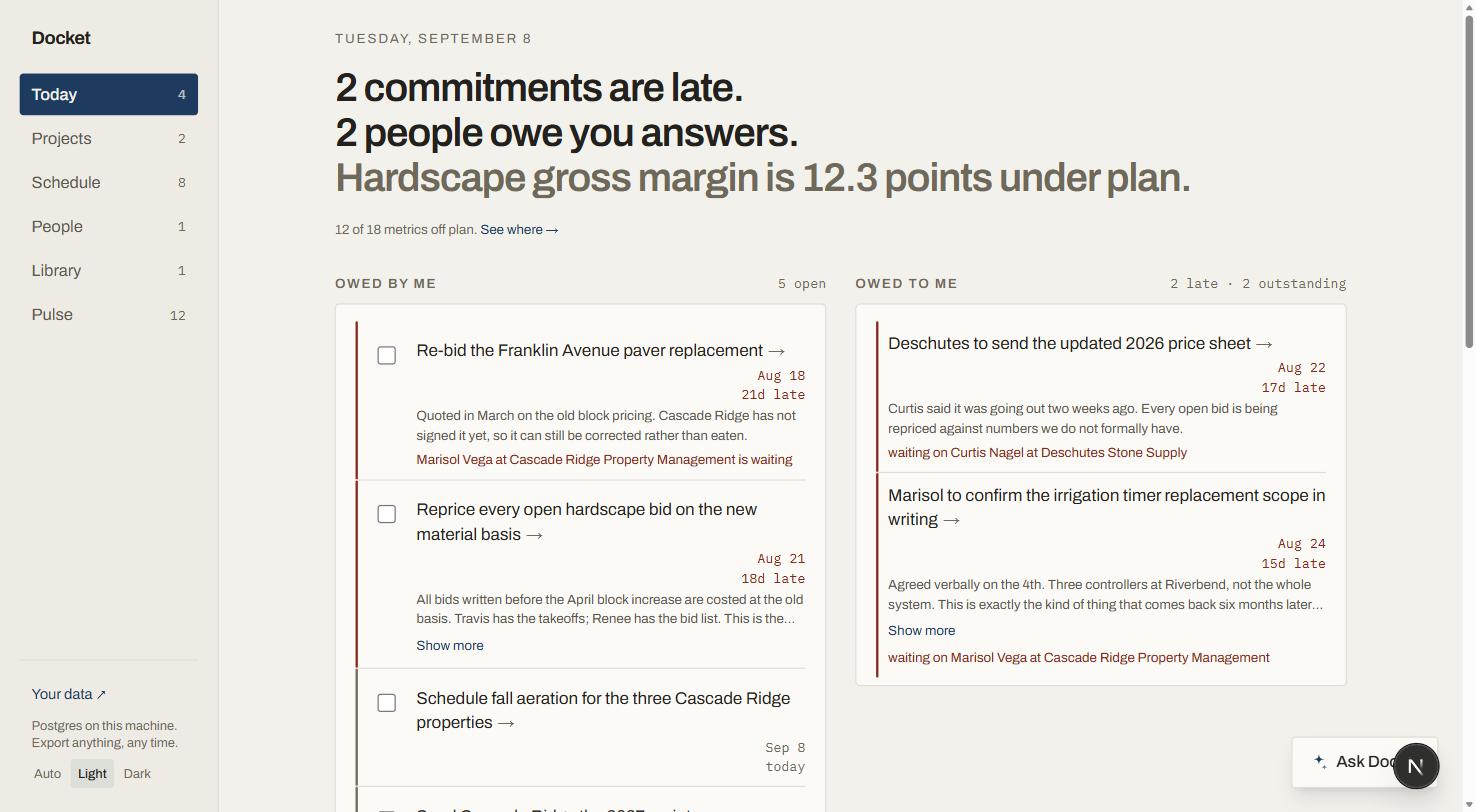
Four zones on one screen. The fourth is the work no deadline will ever make urgent — which is the work that otherwise stays invisible forever.
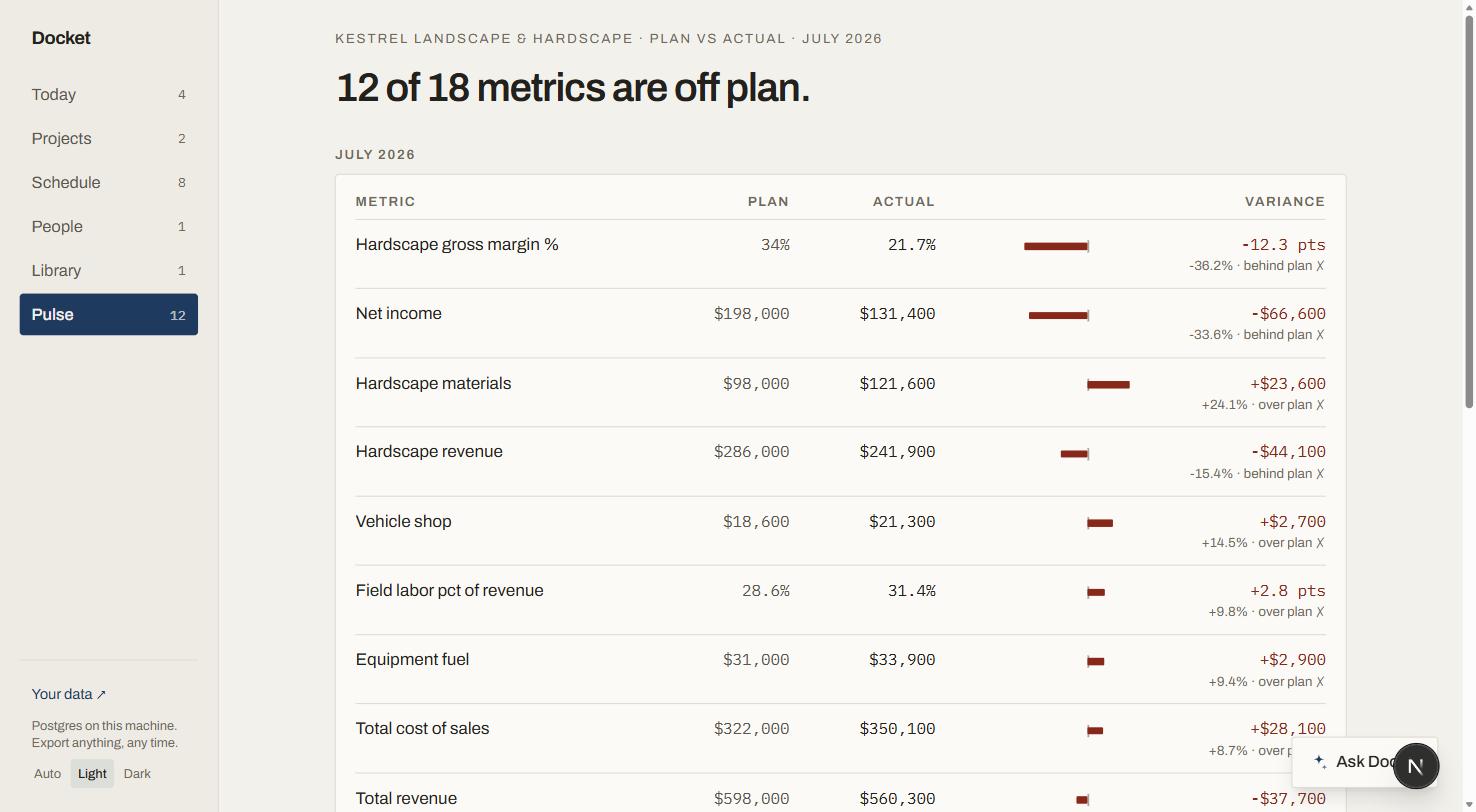
Off-plan counts carry their denominator. Twelve of eighteen is a bad month; twelve of two hundred is a Tuesday.
04Plan vs actual
Over on sales is good news. Over on labour cost is bad news, and the number alone cannot tell them apart.
So every metric carries which direction is good, set by you. One that has not been told is stated and not graded — and draws no bar at all.
Bars are scaled within a period, never across the whole table — one scale over both draws every percentage as a hairline.
05What is coming
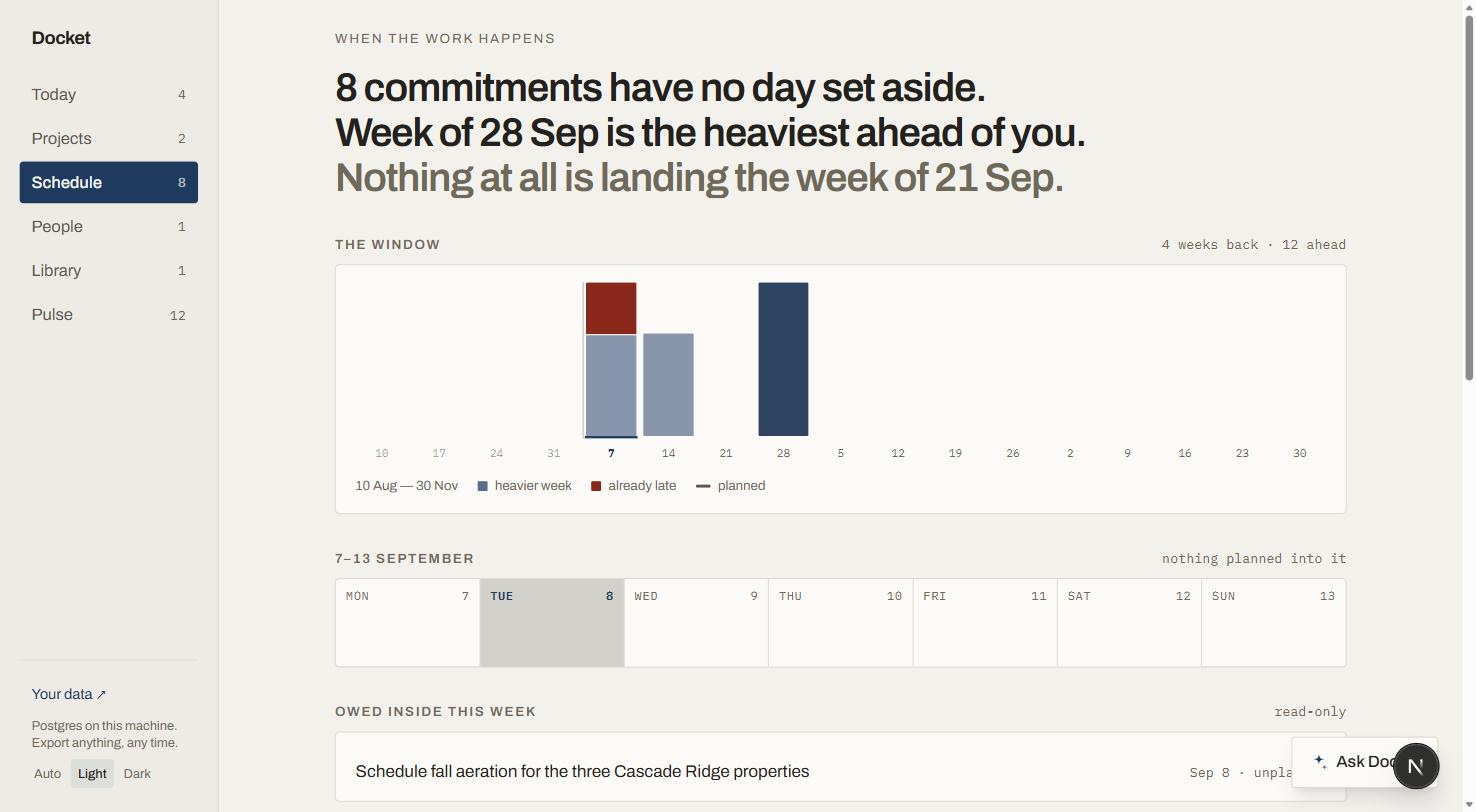
Sixteen weeks, one column each — four behind you and twelve ahead. Nothing is coloured good or bad; a heavy week is just a heavy week.
What you are looking for is the empty column: the room you did not know you had, to move something into.
Work already late sits as a separate cap rather than as part of the week's height — a thing you are late on is a different fact from a thing you have to do.
06In, and back out
You never choose a folder, and you are never asked which job a document belongs to. It is read, indexed passage by passage, and it surfaces on its own wherever it turns out to be relevant.
07Finding it again
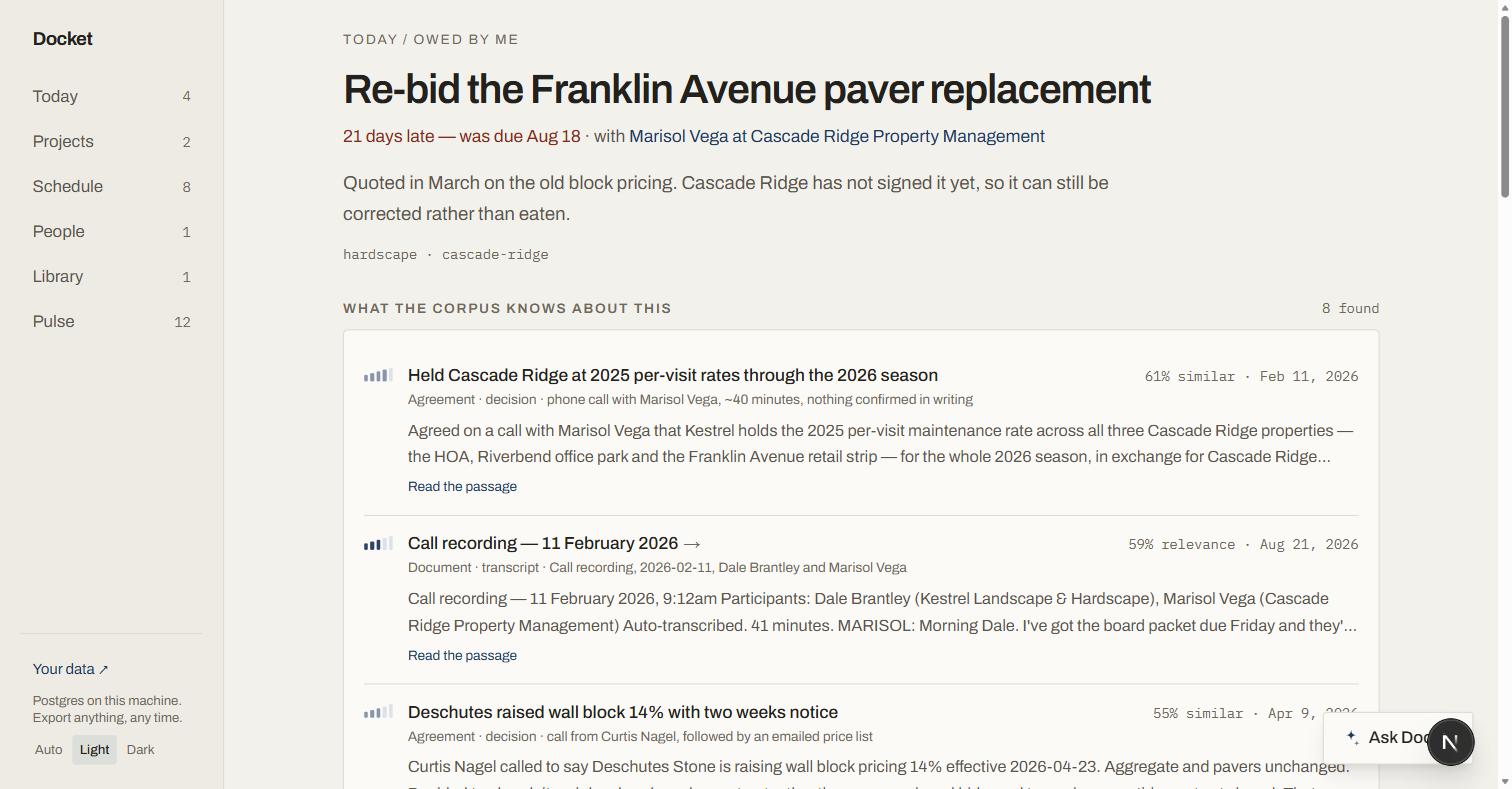
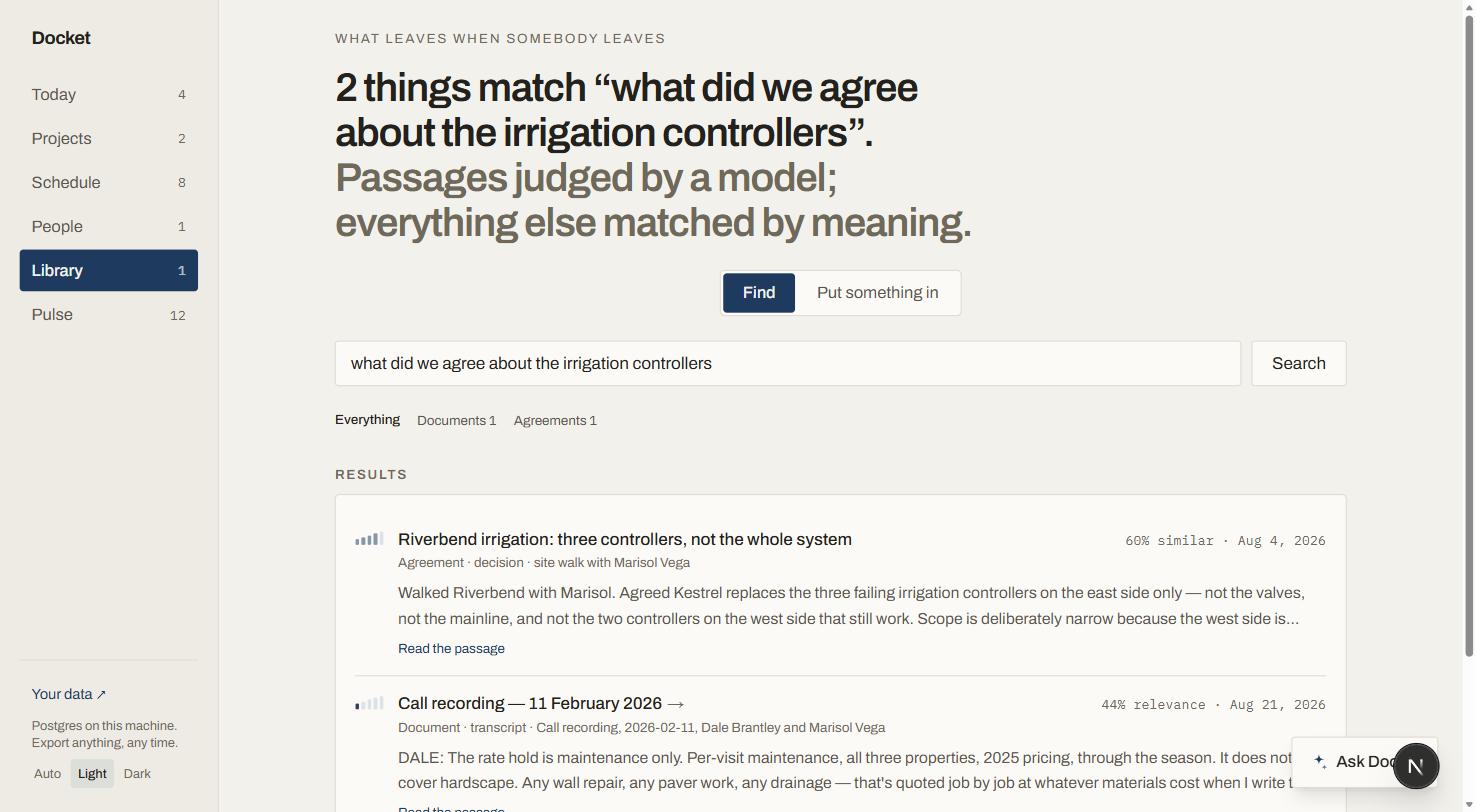
Two passes run — one by meaning, one by wording — and a re-ranking model decides which passages actually answer the question.
Weak matches are dropped rather than shown, because a search that always returns something teaches you to distrust everything it returns.
Each hit says which instrument measured it. A re-ranked relevance and a raw similarity are not the same number, so they are never printed as one.
08Whose record it is
09Where this is today
Early, and run with a small number of businesses rather than sold to anybody who lands on a page.
Everything pictured above, the four ways into the corpus, and the full tool interface.
Importing a profit-and-loss statement — it proposes the numbers, writes nothing until you accept, and re-checks every field before it does.
Calendar sync, jobs, inventory, deals and equipment. Each is designed and deliberately unbuilt until a real business needs it — a table nobody fills is worse than no table.
Self-serve sign-up. An install is stood up with you, on your data, which is why this page asks you to get in touch rather than to enter a card.
10Getting started
The most useful first conversation is not a demo. It is you describing the last time you needed something written down six months ago and could not find it.